

When managing fluids in semiconductor processes, the biggest issues are often the ones that never trigger an alarm. They show up as drift, residue, particles, or a leak that shouldn’t happen. By the time yield drops or maintenance starts digging into root cause, the damage is already done.
Reliability is expected. Uptime is the baseline. The real challenge is managing contamination risk, chemical compatibility, and consistent performance over time. That’s where small decisions around pumps, hoses, and materials can quietly introduce risk that doesn’t show up until it matters.
What makes semiconductor fluids different
Semiconductor fluid systems operate under a completely different set of expectations than most industrial applications. Purity isn’t just important, it’s critical. Contamination at the parts-per-billion level, something that wouldn’t matter in most environments, can ruin wafers and disrupt production.
These processes rely on a wide range of high-purity liquids and gases. Ultrapure water is used for rinsing, aggressive acids and bases handle etching and cleaning, solvents like IPA support precision cleaning steps, and specialty gases enable deposition and doping. Common chemicals such as hydrofluoric, sulfuric, and hydrochloric acid are standard, and each brings its own material compatibility challenges.
With aggressive chemistries and frequent cleaning cycles, every wetted surface becomes part of the process. Pumps, hoses, fittings, and seals aren’t passive components. The materials they’re made from directly impact system cleanliness, chemical resistance, and overall process stability.
That’s why semiconductor applications rely heavily on high-purity plastics and fluoropolymers. Traditional industrial materials simply can’t meet the performance and contamination requirements.
Pump selection: stop treating seals like a consumable

Traditional pump selection assumes seals will wear out, leak, and need replacement. In semiconductor applications, that mindset introduces avoidable risk.
Mechanical seals bring multiple failure points into the system. Elastomer compatibility, thermal cycling, pressure swings, and startup conditions all increase the likelihood of leakage or particle generation. Even a small seal issue can disrupt chemical delivery or create contamination concerns around process tools.
Sealless mag drive pumps eliminate that primary failure path. With no dynamic shaft seal, there’s no direct leak path and far less maintenance over time. That’s why mag drive centrifugal pumps like those from T‑Mag are widely used in semiconductor chemical transfer, circulation, and waste handling, where containment and consistency are critical.
You can explore their platform here:
T‑Mag Pumps
The real advantage goes beyond leak prevention. It’s about stable, repeatable performance over long service intervals without constant intervention.
Pump design removes one set of risks, but material selection introduces another. This is where many systems start to fall apart.
Wetted materials: compatibility is more than a chart
Compatibility charts are a starting point, not the answer.
Most charts assume steady conditions. Semiconductor processes rarely behave that way. Temperature swings, concentration changes, and aggressive cleaning cycles push materials well beyond those simplified assumptions, and that’s where problems show up.
Fluoropolymers like PTFE, PFA, and PVDF are often chosen for their broad chemical resistance, but they don’t all perform the same under heat, stress, or repeated cleaning. Elastomers are even more sensitive, and treating them as interchangeable is a fast way to create failure points.
Real material compatibility means looking at the full picture. Normal operation, upset conditions, and cleaning cycles all have to be considered. What works on paper doesn’t always hold up in the process.
Hose selection: permeation, cleanliness, and bend behavior
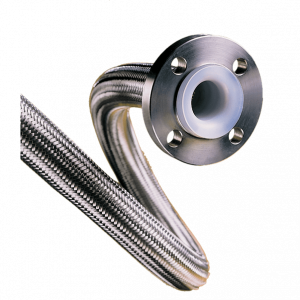
Hoses are often treated like commodity components. In semiconductor fluid handling, they’re anything but.
Under real operating conditions, small differences in hose construction show up quickly. Some materials shed internally when exposed to pressure cycling or tight bend radii. Others kink easily, restricting flow and creating instability in the system. Certain constructions can even allow solvents to permeate over time, releasing vapors or weakening the hose wall.
That’s why high-purity fluoropolymer hoses are typically the go-to for semiconductor applications. They offer low permeation, stable internal surfaces, and documented cleanliness. But material selection alone isn’t enough.
The right hose also has to behave during installation and routing. Bend characteristics, flexibility, and resistance to kinking play just as much of a role as what’s on the spec sheet.
You can see examples here:
PureFlex hose solutions
At that point, everything comes together physically. And that’s where small design choices can create outsized problems.
Connections and changeouts: the overlooked contamination point
Even the best pump and hose setup can fall apart at the connections.
Adapters, dead legs, and mixed fitting styles create places for contaminants to collect. It doesn’t take much. Small inconsistencies in design or assembly can introduce risk that isn’t obvious until performance starts to slip.
How systems are put together matters just as much as the components themselves. Over-tightening, poor alignment, or pushing parts past their intended service life all increase the chance of leaks and contamination.
Maintenance events are where that risk shows up the most. Every time a system is opened, there’s an opportunity for something to go wrong. Designing for clean, repeatable changeouts and minimizing how often they’re needed goes a long way toward keeping systems stable and predictable.
All of these variables add up quickly. Before finalizing anything, it’s worth stepping back and making sure the system holds up under real conditions.
The sanity‑check list before you spec anything
Before you lock in a pump, hose, or material set, take a step back and pressure-test the decision.
Start with the fluid itself. What’s actually in it, including byproducts? Then look at how it behaves in the system. What temperatures will it see during normal operation and during cleaning? What pressures and flow rates are real, not just what’s listed on paper?
Next, think about how the system runs. Is the duty cycle continuous, intermittent, or constantly changing? How clean does the system actually need to be, and how is that being measured or verified?
Finally, consider the failure scenario. What happens when this component doesn’t perform as expected?
In semiconductor fluid handling, “close enough” usually isn’t good enough. The systems that perform best are the ones where potential failure points are addressed early, before they show up in yield data or maintenance logs.